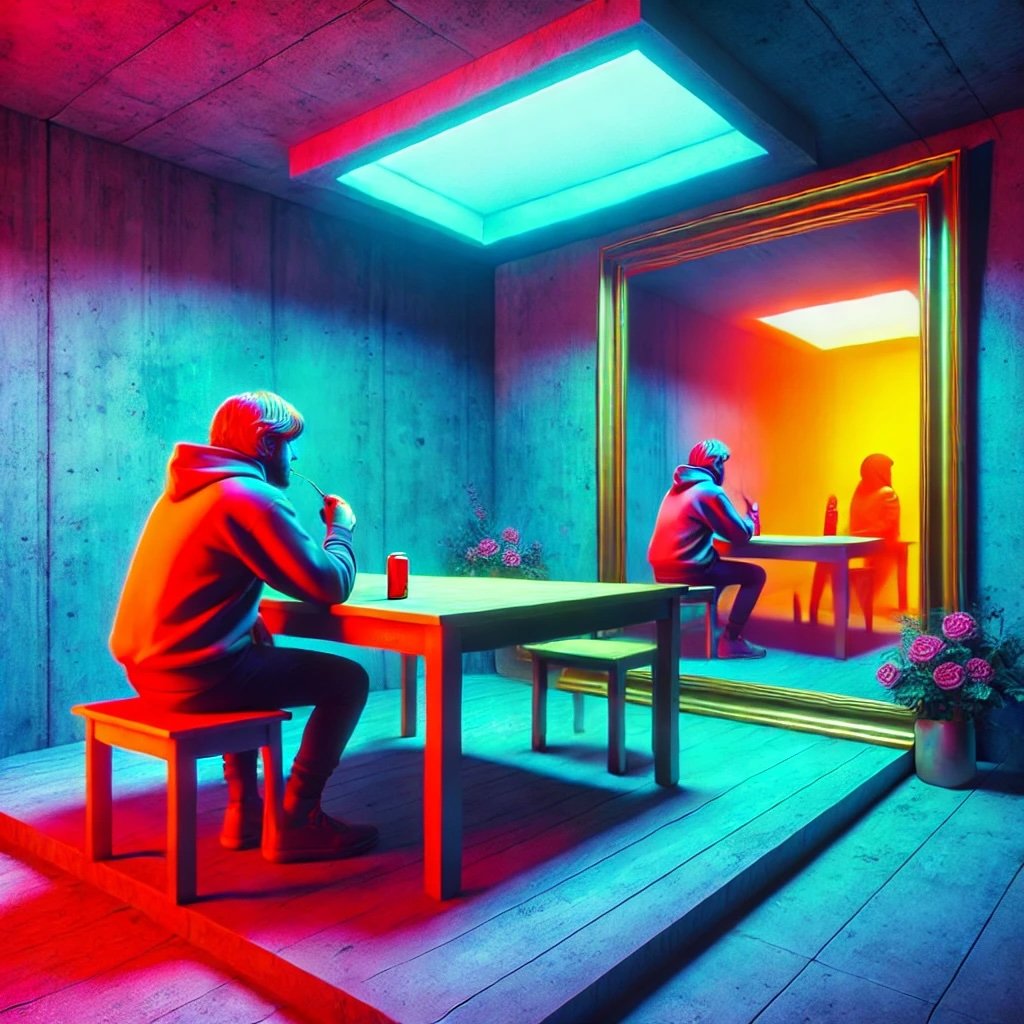
I was once at a close friend’s house. He was an atheist, but used to be a christian. I was agnostic, but used to be christian. We were sitting in his living room, where we both spent a strong majority of our time, and casually he said, “what do you think about god?” I put something down on the table, then I said, “Is there something on the table?” He said “yes.” I looked at the table and squinted my eyes. I asked, “what’s on the table?” He said, “It’s a can of pepsi.” I set my face blank and spun my head to look him in the eyes “prove it.”
Whatever your next thoughts were after reading that story is the topic I want to discuss. The point of the story wasn’t to demonstrate that you can’t prove something about god. It wasn’t to suggest that all aspects of our lives somehow have the same ontological merit. I wasn’t trying to prove one way or the other if god existed. I wasn’t arguing for or against any particular perspective. The story was meant to draw out whatever was HIS criteria for establishing what is and isn’t “real.” He said, “what do you mean, I can see it, it’s right there.” I said, “so for you, whether or not you believe something exists is based on your physical senses.” What about people who hallucinate? Is it because multiple people agree to have sensed the same thing? What of conflicting reports of the same event? How many people have to have agreed to have sensed it before the thing is real? Is it because of how it impacts other things? Because now I’ve changed from the basis of reality being perception, to the basis of reality being impact.
Our entire experience and understanding of the world is written by whatever our criteria are for establishing what is real. I think a lot of people don’t realize that not everyone has the same criteria, or that all of those criteria are deeply flawed. Every last one of them boils down to an unproven assumption. We make these assumptions because we HAVE to. Because without them the world is innavigable. But investigating and understanding the weaknesses of these assumptions can help us to think of the world in a different way. It can help us to move beyond being a regurgitation of our priors, and into a position of relative ideological agency.
Let’s take a closer look at my friend’s criteria: Empiricism.
Many people source their information from physical senses. Particularly sight, sound, and touch. Those are really popular standards for legitimizing the existence of a thing. But what’s happening when we see, or hear, or feel something? Are we really experiencing the raw reality of a corporeal existence? Let’s isolate one so that it’s easier to talk about. Let’s go with sight.
When we think of seeing something, it often carries with it an assumption of authority. We have witnessed a reality. We have been in touch with a thing, and it is there, and it is as we have perceived it to be. According to science (and we will eventually talk about science in this blog), what is happening in that series of moments is that a waveform we call “light” has bounced off of a substance we call “matter.” That wave then traveled to a conglomerate of tissues we call “eyes,” where the signal is converted to a chain of chemical delivery changing the polarity of neurons in rapid succession passing up a chain of tendrils, into a ball of fatty structures where that chain reaction gets proliferated through a network, rendering an output we experience as an “image.” At this point in what is happening, we have not yet interpreted what the image “is.” We have simply achieved the network of electrical transitions required to produce the experience “image.”
The development of the mechanisms necessary to facilitate this series of reactions, the nervous system, was achieved by eons of evolution. What is “evolution?” We like to think of evolution as a process upwards. An iterative development aiming to improve things. But evolution doesn’t aim for anything at all, and it’s not governed by our generalized notions of progress. Evolution is an incremental series of transcription errors. As far as we can tell at this point, it is random. It does not happen on purpose. It does not have a goal. It is an error in the rewriting of a sequence. Whether or not any given permutation of error is passed on is not dictated by whether or not it is “better,” and it is certainly not prioritized by whether or not it increases access to “truth.” But rather it is dictated by its functional capacity to replicate combined by opportunity to replicate. Put simply, does it increase the probability for the subject to reproduce, and for the subject’s spawn to then reproduce, and is that probability met with the necessary opportunity to benefit from that probability of success? It has nothing at all to do with qualitative superiority, and nothing at all to do with answering any grand question about meaning, or purpose, or truth. And it has nothing to do with objective and definitive knowledge regarding any particular thing.
Our eyes’ function is to facilitate navigation. We can navigate our social sphere by recognizing distinct faces. We can navigate our environment by detecting where is good to step. We can navigate tasks by having data for deciding aspects of the items in our vicinity. This is the function of eyes. To give us a specific type of sensory data so that we can make advantageous decisions. This is also the purpose of hearing, and smelling, and feeling, and tasting. Each gives a specific type of sensory data so that we can make advantageous decisions.
To make this navigation work, our brains have evolved to filter out any part of the signal that would distract from self-preserving navigational choices. This is why you can walk down the same road 300 times and never notice the little blue house with white shutters and a path of lillies. Also, to facilitate understanding, our minds interpret the signals from our sensory inputs based on previously established meanings of similar stimuli. Which is why we don’t notice our own typos, or why we mistake someone for someone else. Western music uses a system of twelve semitones. That means the notes within a given octave are divided into twelve even steps. For people who grew up primarily listening to western music, their minds are trained to that particular fragmentation of pitch. Because of this, when they listen to music that uses many more semitones than twelve, they struggle to hear those pitches, or to make sense of the music. Our experience of music is constructed through the experiences we have had before. Our eyes do not show us what a thing “is”. They show us a predictive model based on previous experiences of stimuli. They signal us with a particular class of information that helps us to be more likely to stay not dead more easily for longer.
And this is very cool. For those of us who have this particular type of sensory capability, it has, like the other senses, developed over time to be linked to things like pleasure, and pain, and confidence. These responses, which are largely automated, help to inform us of which decisions might be advantageous. If a sight is pleasant, we are drawn to it. If a sight is unpleasant, we are drawn away from it. And now that we have these qualitative responses, when we look at a beautiful mountain, or flower, or human, it evokes sensations beyond just sight that are enjoyable, pleasant, desirable. And when we see a rotting corpse, or somebody get injured, or we look at something with the capacity to cause damage to our eyes, we feel pain, and we want to look away. And if you don’t know what I mean about it being linked to confidence, I want you to imagine what it would feel like in your stomach to run at speed through a dense forest with your eyes closed. Or to cross the road. I am not recommending that you actually do either of those things.
That confidence helps to keep us alive. We trust our eyes and we respond very quickly if they signal a threat. And that is good. And some of that trust extends to our other senses. Touch, smell, sound, taste. But when I list the other senses, for a lot of people, that same inner sense of authority isn’t there. We still trust those senses to a degree, but there’s no adage in our culture that says “smelling is believing.” The other senses are felt to only tell us some information ABOUT a thing. We could identify something by smell, but we do not at its base think that a smell is what makes something what it is. Whereas seeing a thing establishes the ontological substance of it. It has authority. This authority, though, that we have bestowed upon our eyes, is a fabrication. Our eyes do not tell us what a thing is. Our eyes only tell us how a particular view of a particular moment in time looked, and they only tell us how that moment looked to us.
We get information in text, and that is an amazing construction, but we still only receive it through our own limited senses. And the rest we imagine, or see in pictures. It gives us an opportunity to look beyond our eyes, but the information is still filtered through a long history of imaginations. As we communicated with each other, as we thought and imagined, new words were formed. Each word is an addition that at some point some person created. For every word, one person had to imagine it. They had to imagine the thing that the word seeks to define. They imagined a meaning and gave it a lexeme which they then spoke, at which point it transferred to the imagination of someone else. Every part of it is symbol. Every word has been constructed. And with each new word, our ideological lexicon builds upon itself, and through that text, whether it be written, spoken, or conveyed by movement or gesture or art, our abstractions about reality grow.
We live within the worlds within our mind. A complex idea of systems and realities working together to build an existence. And this existence which has been built out of these ideas is the world in which we navigate. Our decisions from moment to moment are informed by a vast wealth of ideas that makes it feel as if we can see the entire world for what it truly is. It is the necessary mirage to allow us to move about, and we each move about in accordance with our own mirage. But when it comes down to it, when you think about what we are actually working with, the vast majority of everything that has ever happened and ever existed, we know almost nothing about. And even those things that we do know something about, we only know what our own experience of that thing was. We don’t know the truth of it. We don’t know the actual context. It exists as a sensory construction in the context that we have imagined by filling in the blanks between all of the sensory experiences we have actually had. Our world as we know it is an illusion. The precise components of that illusion are different for each person. Our definitions of what is perceived are products of a group project of human navigation which we call history, and language, and culture.
We understand each of us a different rendition of a reality which we have authored together. The very notion of time and story are an imaginative projection to facilitate navigation through a world where we know almost nothing. With very little else to hold onto, we have held onto each other as we careen through these series of moments trying to take ownership of our context so that we can become its master.
What is our proof of what we hold to be true? I’m looking out my window at a tree. I love trees. But what’s happening here? I’m experiencing an image that triggers a memory, an idea of something, and I call that idea “tree,” and I assign a portion of the image with that memory. I am looking at a tree. My notion of that tree is not only different from another culture’s notion. To the person sitting next to me the image might mean to them a moment at their grandfather’s farm swinging from a rope, where they have emotions and ideas about the meaning of a tree based on their own notion of story. To the next person a tree is a hard structure made of a material that can be crafted into art and tool. To me, I look at that tree and my chest feels different. Because, to me, a tree is a thing that allows me to breathe. It is a thing that reminds me that the world is a very slow place. That it is ok to be still.
I am the only thing in the entire world that is having this particular experience at this particular moment. I’m looking at my screen. I’m deciding on lexemes. I’m feeling the keys under my fingers. I’m surrounded by speakers and soda cans. I pile of mail, the image outside, the sound of the heater. And at this time, nobody is aware that I’m having it. This experience, from this particular angle, at this particular moment, with these particular senses, flowing through this particular neurology, filtered through the conceptual lens of my particular story. I am the only person who knows it. As far as I can tell, I am the only person who will ever know it. And the meaning I take from it is also mine alone. And all of the other infinite experiences throughout existence other than my own are a complete mystery to me. Beyond my self I only “know” what I imagine to be happening, and that imagination is based on my own very limited and unique experiences before this moment. We are each suspended in every moment interpreting the stimuli we receive through the lens of the little we have accumulated through our perpetually limited view up until that moment, true or false.
If we are to break free from what we have been taught to assume, one step that for me has been important, was to realize and really consider how very imaginary our day to day experience of what we call “world” really is.


0 Comments